
What Is Business Continuity and Why It’s a Strategic Priority for Leaders
Business continuity is still widely misunderstood.
In many organizations, it’s treated as a technical exercise, a compliance requirement, a checked box requirement, or a binder that lives on a shelf “just in case.” That misunderstanding is costly, wrong, and increasingly dangerous in a business environment defined by cyber threats, operational dependencies, workforce fragility, and constant disruption. This post explains Business Continuity and Why It’s a Strategic Priority for Leaders.
At its core, business continuity is not about disasters. Many get this wrong.
It’s about leadership readiness.
Why Business Continuity Matters Now More Than Ever
Disruption is no longer exceptional. It’s expected.
Power outages, ransomware attacks, vendor failures, key staff absences, cloud service interruptions and regulatory events. These are not hypothetical risks. They are routine realities across every industry and business size.
What separates organizations that struggle from those that endure is not luck.
It’s preparation.
Business continuity ensures that critical operations continue, even when normal conditions do not. It answers fundamental leadership questions:
- What must continue no matter what?
- How long can we tolerate disruption before the business is materially harmed?
- Who decides what gets restored first?
- How do we operate when people, systems, or facilities are unavailable?
These are not IT questions.
They are business decisions with operational consequences.
What Business Continuity Actually Is
Business continuity is a structured discipline focused on maintaining essential functions during disruption. It integrates people, processes, technology, facilities, and third-party dependencies into a coordinated response framework.
A mature continuity approach includes:
- Clear identification of critical business functions
- Defined recovery priorities and timeframes
- Documented response and recovery procedures
- Assigned ownership and decision authority
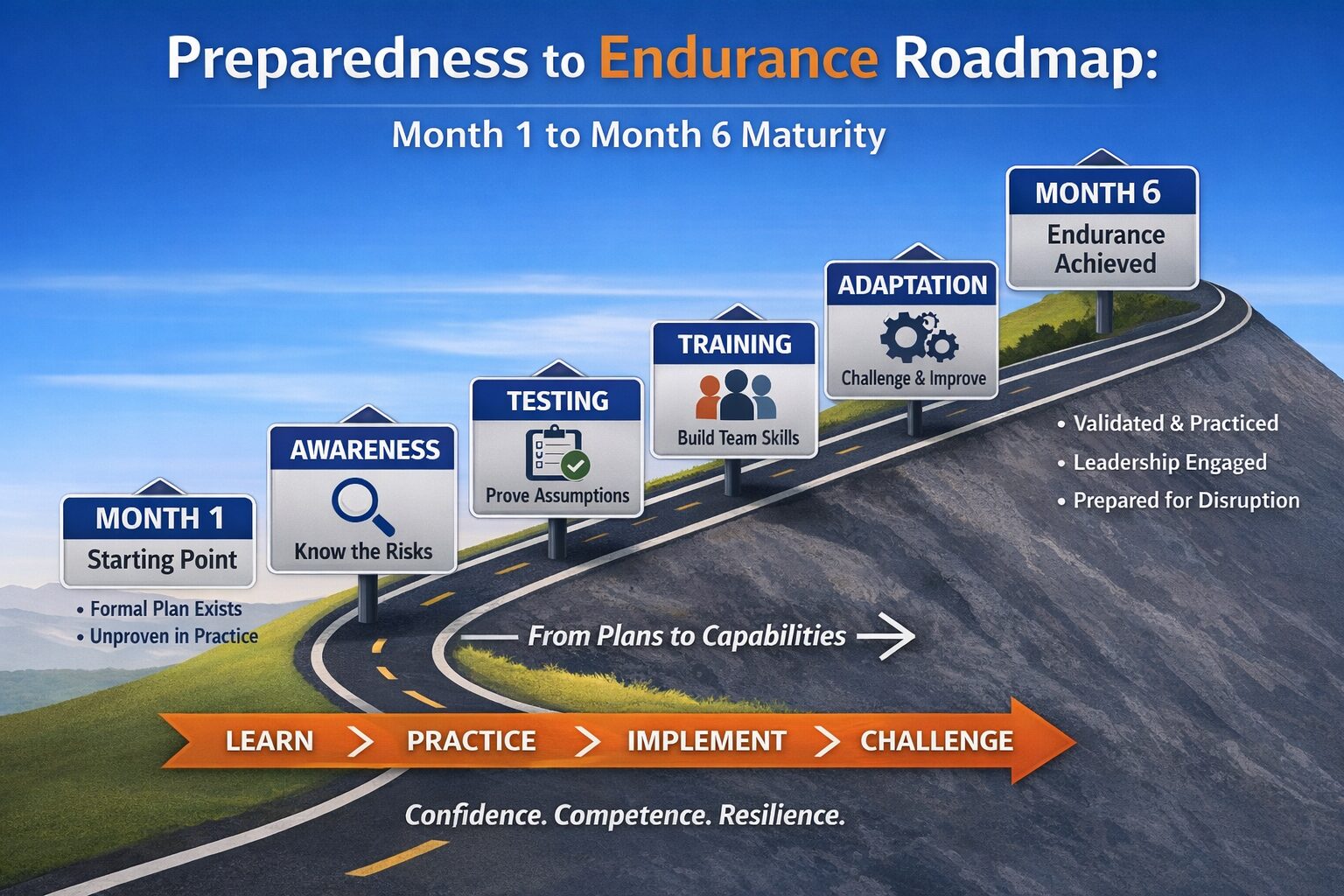
- Regular testing and improvement
Importantly, continuity is a proactive, not reactive, activity. It exists to reduce uncertainty, not to eliminate risk.
Where Leaders Commonly Get This Wrong
The most common failure points in business continuity are not technical. They are organizational.
Some of the most frequent issues include:
- Assuming insurance replaces continuity planning
- Delegating continuity entirely to IT or operations
- Treating plans as documentation instead of decision tools
- Failing to test assumptions before a real event occurs
Another frequent mistake is over-engineering. Leaders sometimes believe continuity must be perfect to be useful. In reality, clarity beats complexity. A simple, well-understood plan that has been practiced will outperform a complex plan no one trusts under pressure.
Continuity as a Leadership Discipline
Effective continuity programs are built from the top down.
Leadership involvement is critical in defining:
- What “critical” truly means to the business
- Acceptable downtime and disruption thresholds
- Tradeoffs between speed, cost, and risk
- Authority during crisis situations
When these decisions are not made in advance, they will be made during an incident. Often under stress, with incomplete information, and with real financial and reputational consequences.
Continuity planning allows leaders to decide once, calmly and deliberately, instead of improvising repeatedly under pressure.
Actionable Steps Leaders Can Take Now
You do not need a massive program to begin building continuity maturity. High-performing organizations start with focus and discipline.
Practical first steps include:
- Identify the business functions that truly drive revenue, safety, and compliance
- Define how long each function can be disrupted before impact becomes unacceptable
- Assign clear ownership for continuity decisions, not just execution
- Validate assumptions through structured exercises or reviews
- Treat continuity as an ongoing capability, not a one-time project
These actions create immediate visibility and reduce uncertainty. Even before formal plans are complete.
A Final Leadership Question
Disruption will happen. That is no longer a question.
The real question for leaders is this:
When disruption occurs, will your organization operate with confidence, or pause while decisions are figured out in real time?
Business continuity is not just about planning for the worst.
It’s about ensuring the business can endure, adapt, and lead through whatever comes next.