
Financial Impact Analysis: Turn Business Disruption Into Decision-Grade Financial Intelligence
Author: Keith Erwood
Date: 09/01/2026
What would a serious disruption actually cost your organization — and what is recovering sooner financially worth?
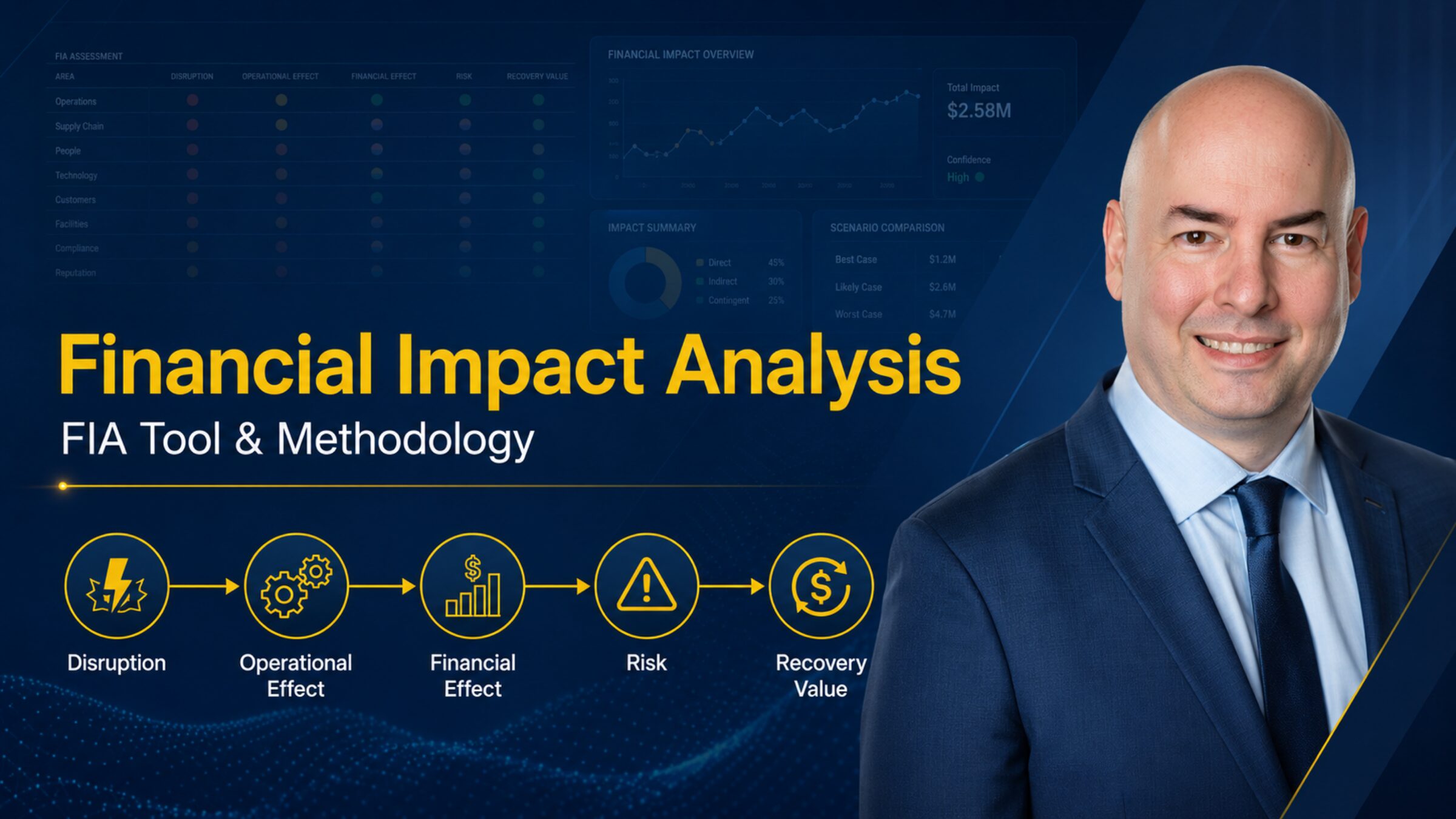
A Fiancial Impact Analysis goes further than most other tools and assessments in outlining the financial impacts to businesses. Traditional business continuity assessments can tell you which processes are important. Downtime calculators can estimate what an hour of outage might cost. Risk assessments can describe likelihood and severity. But senior leaders eventually need a more difficult answer: what is the financial consequence of this specific disruption, what drives that consequence over time, what can be recovered, and how much financial exposure can be avoided by improving resilience?
The Financial Impact Analysis (FIA) is designed to answer that question. It is a structured financial assessment of business disruption that translates operational consequences into an evidence-based financial model. FIA considers more than lost revenue. It can quantify productivity loss, incremental recovery costs, operational expenses, asset and data consequences, contractual and regulatory impacts, insurance and other recoveries, longer-term effects, liquidity stress, annualized risk, and the financial value of a faster recovery target.
The result is not simply a “cost per hour.” It is a decision framework that helps executives understand the economics of disruption and make more defensible decisions about recovery objectives, business continuity, disaster recovery, cybersecurity, third-party resilience, operational resilience, insurance, capital investment and risk acceptance.
Schedule a Financial Impact Analysis Consultation
Talk with us about the disruption scenario, business service, technology, facility, supplier, or operational dependency you need to quantify. We can determine whether a focused FIA or a more comprehensive enterprise assessment is the right fit.
About the Practitioner
Keith Erwood, CBCP, is a business continuity, disaster recovery, operational resilience, and financial-impact consultant with more than 20+ years of experience helping organizations understand disruption risk, establish recovery requirements, and build practical recovery capabilities.
His work spans business continuity, Business Impact Analysis (BIA), Financial Impact Analysis (FIA), disaster recovery, crisis management, risk assessment, dependency analysis, recovery strategy, and resilience planning across complex, highly regulated, and mission-critical environments.
Keith has completed or led more than 120 risk, business impact, and financial impact assessments, facilitated more than 125 continuity workshops, developed more than 100 business continuity plans, and created more than 50 disaster recovery plans and runbooks, over the last six years alone.
His experience includes engagements supporting organizations such as JetBlue, Illumina, SHARP HealthCare, Lawrence Berkeley National Laboratory, Cost Plus World Market, and other enterprise clients. His work has included reducing recovery objectives, protecting critical revenue sources, strengthening global continuity programs, supporting high-availability and hybrid-cloud recovery, and helping organizations translate operational disruption into business and financial consequences.
Keith is a Certified Business Continuity Professional (CBCP) through Disaster Recovery Institute International and is an author, speaker, and recognized thought leader in business continuity and resilience.

Keith Erwood, CBCP
What Is a Financial Impact Analysis?
A Financial Impact Analysis is a structured assessment that estimates the economic and cash-flow consequences of a defined business disruption scenario. It connects the operational event to the financial effects that matter to management.
The core question is: What is the financial impact of this disruption over time, what is driving that impact, and what is the financial value of recovering sooner?
FIA can be used prospectively before an event, during an active disruption as facts emerge, or after an event to reconcile actual losses and recoveries. The method is designed to preserve the distinction between estimated exposure and observed financial results rather than overwriting the original assumptions once an event begins.
What Problems Does FIA Solve?
- Your BIA identifies critical processes and RTOs, but leadership cannot explain the financial basis for the recovery targets.
- A technology or cyber team wants funding for resilience, redundancy or faster recovery but cannot demonstrate the expected economic value of the investment.
- Executives receive a downtime number that assumes every dollar of revenue exposure is permanently lost.
- Different departments estimate the same consequence in different places, creating a risk of double-counting.
- Insurance, deferred revenue, salvage and reimbursements are mixed into the loss calculation in ways that make the result difficult to defend.
- A disruption may not create an accounting loss large enough to threaten the company, but it could create a significant short-term liquidity problem.
- Risk leaders know an event could be expensive but cannot translate a scenario into annualized financial exposure.
- A business wants to compare the cost of resilience to the financial exposure avoided by recovering in two hours instead of eight hours.
- Management needs an evidence trail showing which values are verified, estimated, assumed, unresolved or still awaiting documentation.
The Business Value of FIA
The value of FIA is not the spreadsheet or the mathematical mechanics. The value is the quality of the decisions that become possible when disruption is expressed in financial terms.
Establish financially defensible recovery objectives
Instead of selecting an RTO because “four hours sounds reasonable,” FIA can show how the financial impact develops at 15 minutes, 30 minutes, one hour, two hours, four hours, eight hours and beyond. That allows management to connect recovery time to economic consequence.
Build stronger business cases for resilience investment
FIA compares the current financial impact of a disruption with the expected impact under an improved recovery target. That creates an estimate of exposure avoided per event, annual risk reduction, payback and net present value.
Improve executive and board communication
Technical recovery language becomes financial language. Executives can evaluate event impact, annualized risk, liquidity stress and resilience investment using metrics that align with budgeting, capital allocation and enterprise risk.
Separate economic loss from cash-flow stress
An organization may eventually collect deferred revenue or receive insurance proceeds and still experience a severe short-term cash requirement. FIA treats liquidity as a separate management question rather than adding it to Gross Financial Impact.
Reduce double-counting and inflated loss estimates
The method requires one economic consequence to have one additive owner. Revenue, labor, recovery, operational expenses, asset losses, legal costs and recoveries are evaluated for overlap before they are added.
Create an evidence-based assessment record
Material values can be associated with a source, owner, confidence level and evidence requirement. Estimates are not presented as facts simply because a formula contains them.
Support insurance and recovery conversations
FIA separates gross loss from insurance, reimbursements and other recoveries, making it easier to understand the gross event economics and the expected net financial position.
Quantify risk in annual terms
Event financial impact can be combined with estimated annual frequency to calculate Expected Annual Loss (EAL), creating a common financial basis for comparing scenarios and investments.
Schedule an FIA Discovery Meeting
A Broader View of Business Disruption
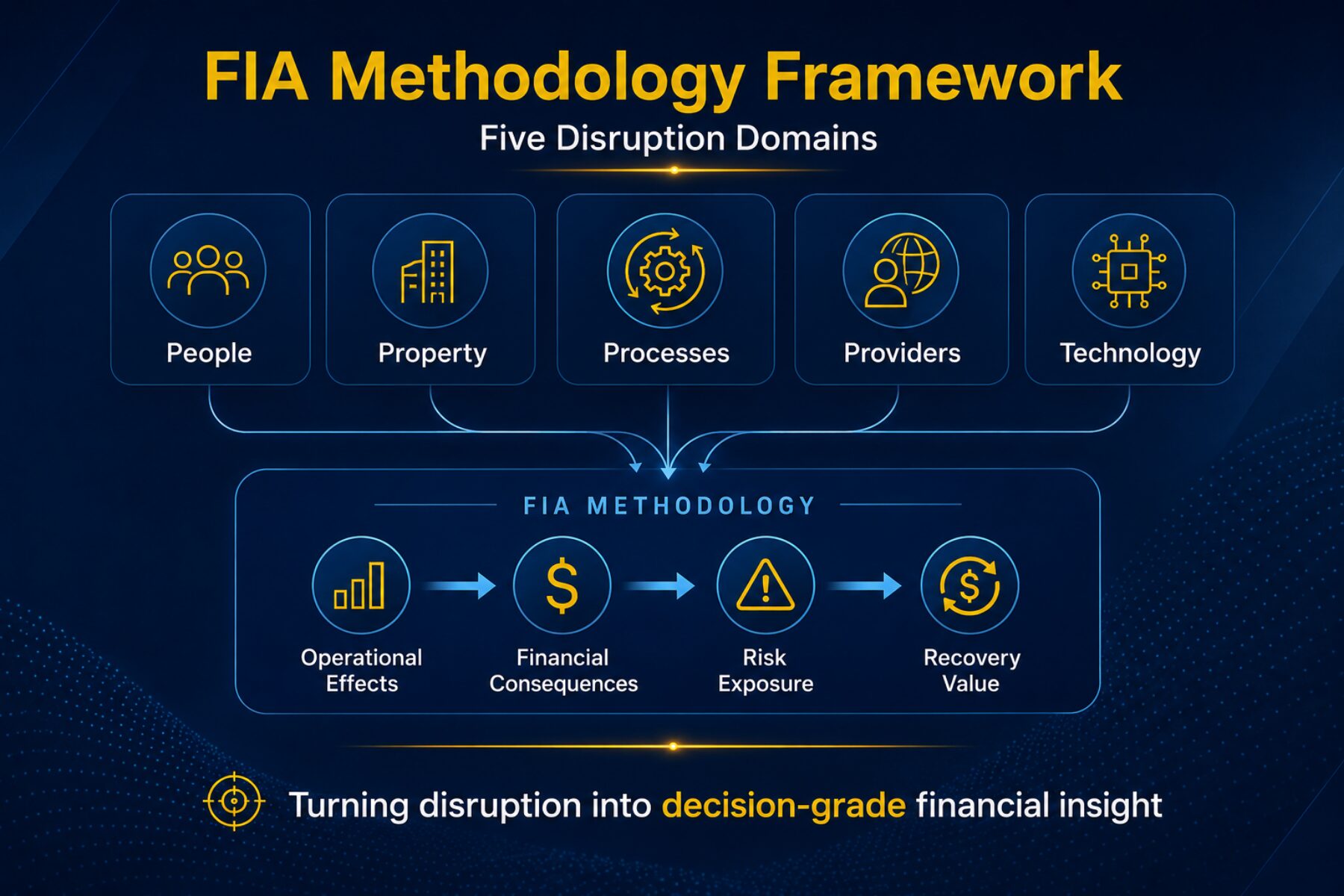
Many downtime tools begin and end with technology. FIA does not assume technology is the only cause of disruption. A business can be financially affected by failures involving people, property, processes, providers, or technology. External events can also initiate the disruption.
The assessment follows a simple logic:
Trigger → Dependency → Operational Effect → Financial Effect
That allows the same financial methodology to support technology outages, cyber incidents, supplier failures, facility interruptions, workforce disruptions, manufacturing events, data loss, operational breakdowns, and other scenarios where the business consequence is more important than the technical cause.
What the FIA Can Quantify
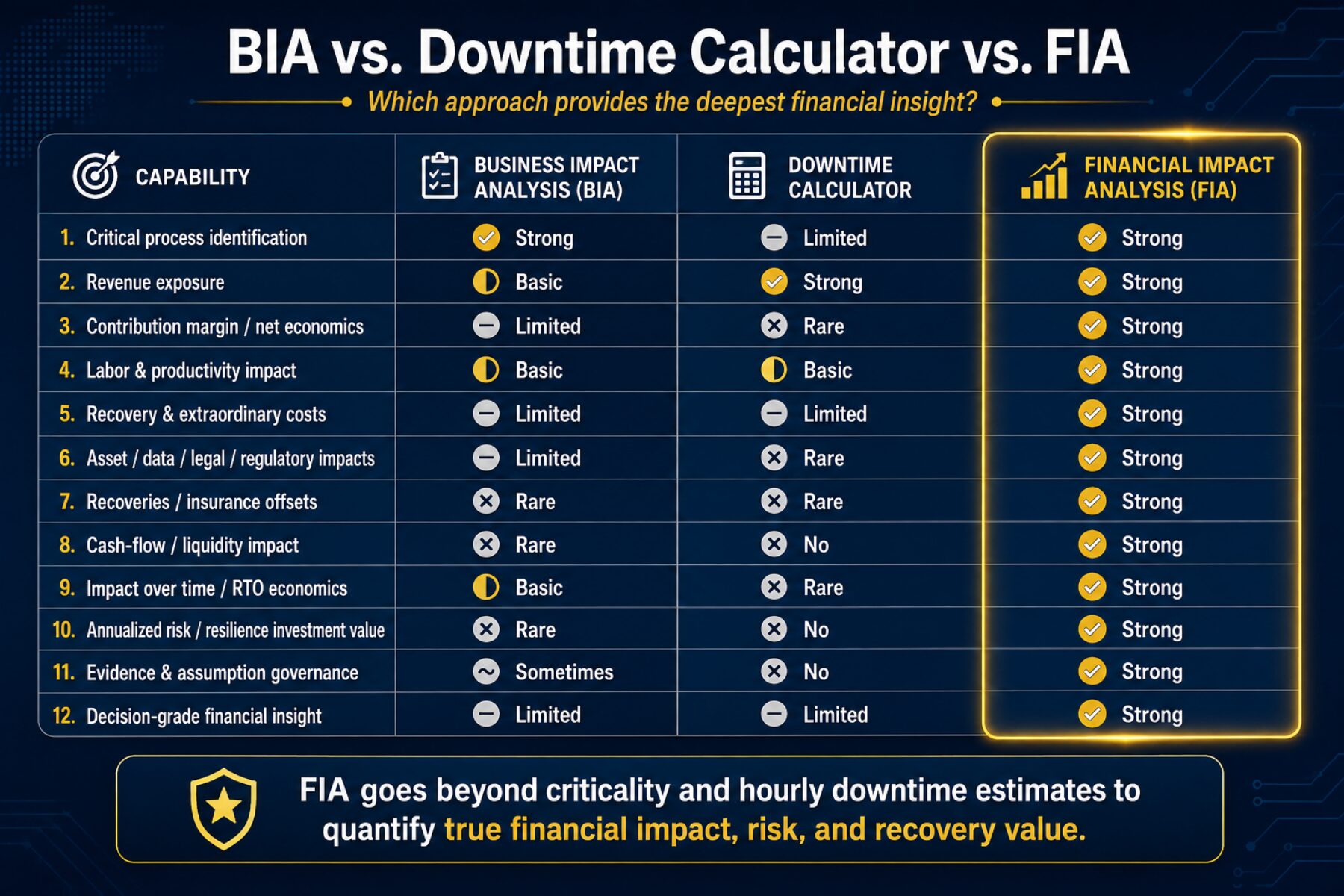
FIA combines capabilities that are often distributed across separate BIA, downtime, risk, insurance and resilience tools. The table below shows the breadth of the assessment.
| Capability | Typical BIA | Simple Downtime Calculator | Quantitative Risk / CRQ | Financial Impact Analysis |
|---|---|---|---|---|
| Revenue exposure | Sometimes | Yes | Yes |
Yes |
|
Permanent vs. deferred revenue |
Rare | Rare | Sometimes | Yes |
| Contribution-margin economics |
Sometimes |
Rare | Sometimes | Yes |
| Employee productivity | Sometimes | Yes | Sometimes |
Yes |
| Incremental recovery labor | Limited | Sometimes | Yes | Yes |
| Operational extraordinary costs | Sometimes | Limited | Yes | Yes |
| Asset and data reconstruction | Sometimes | Rare | Often cyber-specific | Yes |
| Contractual, legal and regulatory costs | Sometimes | Rare | Yes | Yes |
| Recoveries / insurance as separate offsets | Rare | Rare | Sometimes | Yes |
| Secondary / longer-term effects | Usually qualitative | Sometimes estimated | Yes | Yes |
| Economic impact vs. liquidity | Rare | No | Rare | Yes |
| Impact curve over time |
Sometimes qualitative |
Usually linear | Yes | Yes |
| Expected Annual Loss / EAL |
Rare |
No | Yes | Yes |
| Recovery improvement economics | Rare | Sometimes | Yes |
Yes |
| NPV and payback of resilience | Rare | Rare | Yes | Yes |
| Evidence/source/confidence governance | Sometimes | No | Yes | Yes |
| Actual-to-date → projected ultimate | Rare | No |
Sometimes |
Yes |
| Explicit double-count ownership controls | Rare | No |
Model-dependent |
Yes |
| Business disruption beyond cyber/IT | Yes | Usually IT-centric | Often cyber-centric |
Yes |
Important: The comparison is directional, not a claim that every BIA, downtime calculator or risk platform has the same limitations. Enterprise platforms vary widely. FIA is designed specifically to provide transparent financial quantification of business disruption and recovery value.
Why FIA Goes Beyond a Traditional Business Impact Analysis (BIA)
A Business Impact Analysis is essential for business continuity and operational resilience. A good BIA identifies critical activities, dependencies, impact tolerances, RTOs, RPOs and recovery priorities. FIA is not intended to replace the BIA. It addresses the financial questions that often remain after the BIA is complete.
A BIA may conclude that a business service must recover within four hours. FIA asks: what happens financially at two hours, four hours, eight hours, 24 hours and 48 hours? Which losses are permanent? Which revenue is merely delayed? What expenses are truly incremental? What is recoverable through insurance or other offsets? Does the event create a liquidity problem? What is the annualized risk? And what is it worth to recover in two hours rather than four?
BIA prioritizes criticality; FIA quantifies economics.
Criticality does not necessarily equal financial loss. FIA turns business impact into monetary exposure that executives can compare with investment and risk tolerance.
BIA establishes recovery requirements; FIA tests the financial basis.
FIA can support or challenge a proposed RTO by showing the financial impact curve over time.
BIA may use impact ratings; FIA produces financial outputs.
High/medium/low ratings are useful for prioritization. FIA complements them with event loss, liquidity, annualized risk and recovery-value metrics.
BIA often treats financial impact as one field; FIA decomposes it.
Revenue, labor, recovery expense, operational cost, asset/data loss, legal/regulatory consequences and recoveries are treated separately to improve explainability and reduce overlap.
BIA identifies dependencies; FIA monetizes the consequences of dependency failure.
The same dependency information can become the basis for estimating the financial consequences of supplier, facility, workforce, process or technology disruption.
Why FIA Goes Beyond a Downtime Cost Calculator
A downtime calculator is useful when the question is narrow: “What might an hour of outage cost?” The problem is that many simple calculators multiply revenue or employee cost by time and treat the result as loss. That can be directionally useful, but it can also overstate or misunderstand the economics of a real disruption.
- Revenue exposure is not automatically revenue loss. Some transactions are deferred, shifted to another channel, recovered later or unaffected.
- Lost revenue is not the same as lost profit or contribution margin. FIA can use contribution margin as the primary additive revenue-impact measure.
- Employee payroll is not automatically an incremental loss. FIA distinguishes economic lost productivity, regular payroll context, overtime, temporary staffing and other incremental labor.
- Recovery expense can involve internal normal-hours effort, overtime, external specialists, retainers and standing costs with different financial treatments.
- Operational expenses may appear only after certain thresholds — for example temporary facilities, expedited logistics, security, travel or emergency procurement.
- Asset and data consequences can involve economic replacement, restoration, salvage, backup recovery and reconstruction costs that do not behave like a simple hourly rate.
- Contractual and regulatory consequences may trigger after specific durations rather than rising linearly with time.
- Insurance and reimbursement should offset gross loss once, not be mixed into every cost category.
- Short-term liquidity stress can be severe even when some economic losses are eventually recovered.
- The financial value of an improved RTO requires comparing the entire event model at two different recovery durations, not simply multiplying an hourly average.
What Is Included in an FIA Engagement?
The scope of each engagement depends on the scenario and available evidence. A full FIA can examine the following financial pathways.
Organization and scenario definition
Define the legal/operating scope, annual revenue, operating schedule, contribution margin, initiating disruption, affected business activity, residual capacity and relevant disruption durations.
Revenue and margin impact
Estimate gross revenue exposure, permanently lost revenue, deferred/recoverable revenue, substituted/unaffected revenue and additive contribution-margin loss. More detailed transaction or time-pattern methods can be used when justified by the data.
People and labor
Estimate economic lost productivity across affected employee groups and separately identify incremental overtime, temporary staffing, emergency labor, incentives or other event-driven labor costs.
Recovery costs
Capture internal recovery effort, external contractors and specialists, overtime, event-related retainer charges and other recovery resources without automatically treating standing costs as incremental loss.
Operational and extraordinary costs
Evaluate temporary facilities, workarounds, logistics, travel, rental infrastructure, communications, security, emergency procurement and avoided costs.
Assets, facilities, inventory and data
Model economic restoration or replacement of physical assets, inventory/spoilage, salvage value, data reconstruction, backup recoverability and the risk of double-counting labor or vendor effort.
Contractual, regulatory and legal
Estimate SLA credits, penalties, regulatory consequences, notification/remediation, investigation and legal/compliance response, including probability-adjusted amounts where appropriate.
Insurance, reimbursement and offsets
Separate gross financial impact from expected or actual recoveries, deductibles, limits, waiting periods, probability of collection, reimbursements, credits and other offsets.
Secondary and longer-term impacts
Evaluate lower-confidence consequences such as customer churn, strategic delay, employee attrition or other downstream effects while keeping them separately labeled from Core Direct Financial Impact.
Liquidity and cash-flow stress
Model opening liquidity, committed credit, minimum reserve, normal receipts/outflows, emergency cash expenses, recovery timing and projected minimum available liquidity.
Risk and Expected Annual Loss
Combine event financial impact with annual frequency to estimate EAL and provide a common annualized view of financial risk.
Resilience economics
Compare current and improved recovery performance to estimate exposure avoided per event, annual risk reduction, investment payback, benefit-cost ratio and NPV.
What You Receive From the Financial Impact Analysis
The goal is not to create a large spreadsheet full of numbers. The goal is to produce a financially coherent decision package that management can understand, challenge and use.
- A defined business-disruption scenario with documented scope and dependencies.
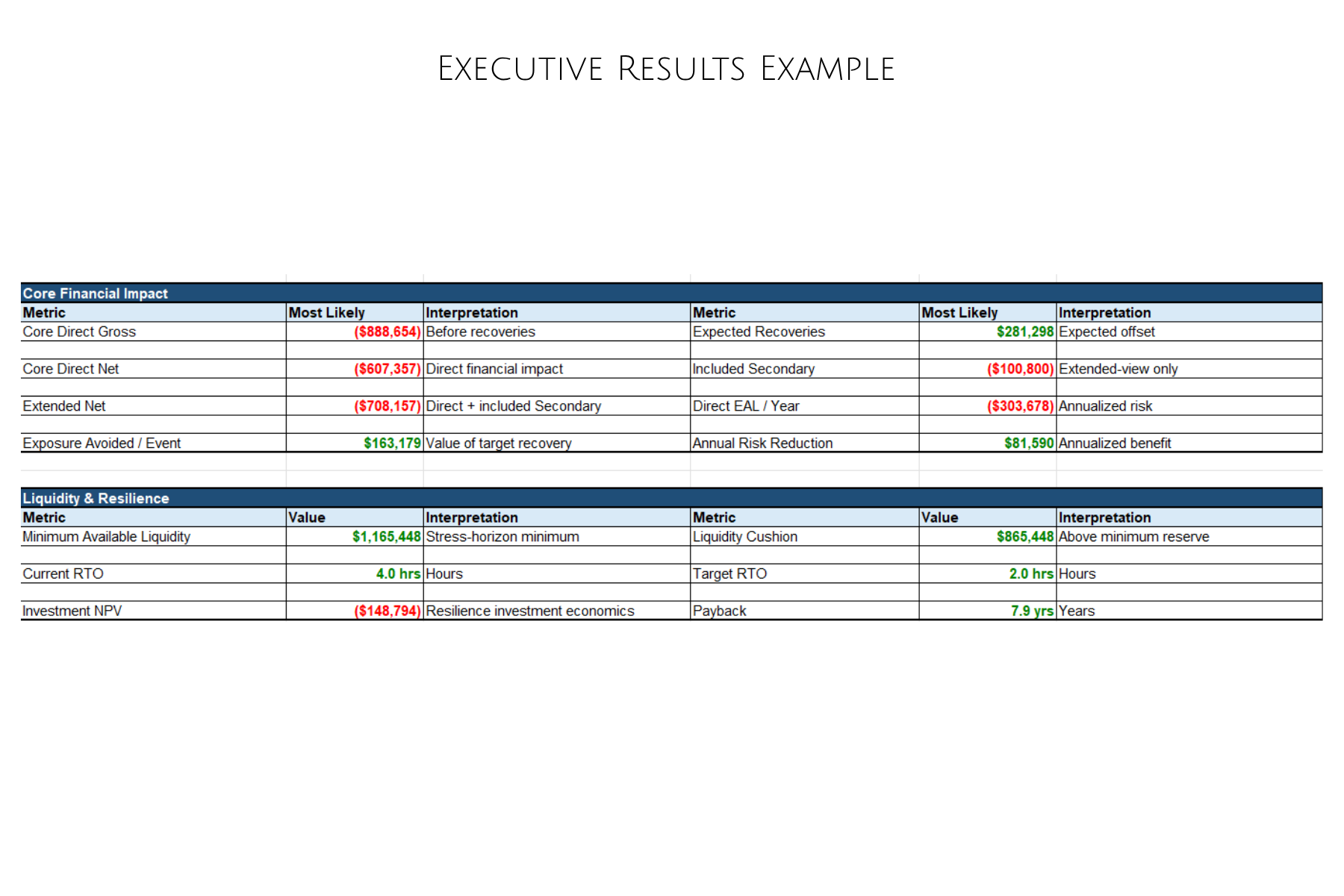
- Core Direct Gross Financial Impact before recoveries.
- Expected or actual recoveries and offsets.
- Core Direct Net Financial Impact after recoveries.
- A separately identified Extended Net view when longer-term impacts are justified.
- A financial impact curve showing how consequences develop over time.
- Estimated liquidity stress and minimum available liquidity during the modeled horizon.
- Expected Annual Loss / annualized risk for the selected scenario.
- Current versus target recovery economics.
- Exposure avoided per event and annual risk reduction.
- Investment payback and NPV where a resilience investment is being evaluated.
- Evidence, assumptions, ownership decisions and unresolved items documented for review.
- An executive-ready result set that can support business cases, risk discussions, resilience planning and recovery objectives.
When Should an Organization Use FIA?
Financially defensible RTOs
Use FIA when recovery objectives exist but their economic basis is unclear, inconsistent or difficult to explain to executive leadership.
Business continuity and operational resilience
Use FIA to supplement BIA results with financial quantification for the business services and scenarios that deserve deeper analysis.
Disaster recovery and technology resilience
Quantify the business value of faster application, infrastructure, cloud, telecommunications or data recovery.
Cyber and ransomware scenarios
Translate operational interruption, recovery costs, data consequences, legal/regulatory exposure and business impacts into a unified financial view.
Third-party and supplier disruption
Model the consequences of losing a critical provider, logistics partner, outsourcer, manufacturer or service supplier.
Facility and manufacturing interruption
Assess production, inventory, temporary facility, logistics, labor, equipment and customer consequences associated with physical disruption.
Insurance and risk financing
Understand gross loss, recoverable amounts, net financial exposure and liquidity timing before discussing risk transfer and limits.
Capital and resilience investment
Compare the cost of redundancy, alternate capacity, automation, recovery improvements or other controls with the modeled financial exposure avoided.
Post-event loss reconciliation
Preserve the original estimate, track actual-to-date results, estimate remaining impact, project ultimate loss and reconcile final actual results as evidence matures.
Find Out What a Disruption Is Financially Worth
How an FIA Engagement Works
A facilitated FIA is designed to combine financial analysis with structured business knowledge. The exact engagement plan is scaled to the scenario, but a typical engagement follows six stages.
1. Scope the decision
Define the business question, disruption scenario, organizational boundary and executive decision the analysis needs to support.
2. Request evidence
Identify the financial, operational, technical, insurance, contractual and risk information that can support the assessment.
3. Conduct structured workshops
Meet with the right business and functional owners to validate dependencies, consequences, timing, workarounds, financial pathways and uncertainty.
4. Build and reconcile the financial model
Complete the FIA, challenge assumptions, remove duplicate economics, distinguish additive losses from context values and calculate the impact across time.
5. Validate assumptions and outcomes
Review estimates with Finance, Treasury, Operations, Technology, Legal, Risk, Insurance or other relevant stakeholders. Resolve material evidence and overlap issues.
6. Present the executive case
Translate the analysis into decision metrics: direct net impact, extended impact where applicable, liquidity, EAL, recovery economics and the value of resilience improvements.
What Makes the FIA Approach Different?
Revenue exposure is not treated as automatic loss
FIA explicitly separates exposed revenue from permanent loss, deferred/recoverable revenue, substituted/unaffected revenue and unresolved exposure.
Gross and net financial impact remain separate
Recoveries are applied after gross losses are calculated, improving transparency and avoiding hidden netting.
Economic impact and liquidity are different questions
Liquidity stress is modeled independently and is never added to Gross Financial Impact.
Impact is allowed to be nonlinear
Threshold costs can appear at different durations. A four-hour event is not assumed to be exactly twice the cost of a two-hour event.
Double counting is actively governed
Overlapping economic pathways are explicitly reviewed rather than simply summed.
Evidence quality is visible
A client estimate, consultant estimate, model assumption and verified source are not treated as equivalent.
Risk and resilience are linked to the event economics
FIA can move from event loss to annualized risk and then to the financial value of improved recovery.
The assessment can mature during a real event
Original Estimate, Actual to Date, Estimated Remaining, Projected Ultimate and Final Actual can remain distinct instead of rewriting history as new information appears.
Executive Questions FIA Helps Answer
- What is our estimated net financial impact if this disruption lasts four hours? Eight hours? Twenty-four hours?
- Which financial consequences drive the event — revenue, labor, recovery expense, operational cost, asset/data loss or contractual/regulatory exposure?
- How much of the exposed revenue is actually expected to be permanently lost?
- How much of the gross loss could be recovered through insurance or other offsets?
- Could the event create a cash or liquidity problem before recoveries arrive?
- What is our expected annual financial exposure to this scenario?
- What is the financial value of improving recovery from eight hours to two hours?
- Does the proposed resilience investment have a defensible payback or positive NPV?
- Which assumptions are verified, which are estimates and which still require evidence?
- Are we double-counting any economic consequences across departments?
- What information should we improve before presenting this risk to the board, regulator, insurer or investment committee?
Practitioner Experience Behind the Financial Impact Analysis Methodology
Built From Real-World Business Continuity, Disaster Recovery and Financial-Impact Work
The Financial Impact Analysis approach is grounded in a practical problem encountered repeatedly in business continuity and disaster recovery work: organizations often know that a process, application, facility, supplier, or service is critical, but they cannot clearly explain what its disruption would cost, when the financial consequences become material, what is actually driving the loss, or what faster recovery is financially worth.
The FIA methodology reflects the direct practitioner experience of Keith Erwood, CBCP, a business continuity, disaster recovery, operational resilience, crisis management, and financial-impact consultant with more than 20+ years of experience working with complex organizations and mission-critical operations.
Keith’s career has involved working directly with business leaders, finance teams, technology organizations, recovery teams, operational stakeholders, vendors, risk professionals, and executive sponsors to understand how disruptions develop and what organizations actually need in order to continue or recover.
That experience includes work across healthcare, aviation, biotechnology, research, retail, technology, and other enterprise environments.
Experience That Connects Business Impact to Recovery Decisions
Keith’s work has gone well beyond producing continuity documents.
At Lawrence Berkeley National Laboratory, his work contributed to reducing recovery objectives that had previously been set at approximately 45 days to three days, helping protect time, resources, and more than $139 million in revenue sources.
For Cost Plus World Market, he designed, implemented, and tested an off-site disaster recovery solution supporting a critical payment-processing database responsible for more than $1 billion in annual transactions.
At Illumina, he helped bring a global business continuity program that had remained incomplete for more than five years to completion—directing dozens of BIAs, continuity plans, and exercises while reestablishing executive sponsorship. Program effectiveness also contributed to a reported $500 million increase in insurance coverage without a premium increase.
For JetBlue, Keith developed disaster recovery plans and scenario-based runbooks for critical systems operating in multi-hybrid-cloud and high-availability environments with complex upstream and downstream dependencies.
His consulting experience at SHARP HealthCare included business continuity, Business Impact Analysis, emergency management, recovery operations, crisis preparedness, and disaster recovery across a healthcare system consisting of seven hospitals and three medical groups.
Quantitative Experience, Not Just Theory
In the past six years alone, Keith has completed or led more than:
- 120 risk assessments, Business Impact Analyses, and Financial Impact Analyses
- 125 business continuity workshops
- 100 business continuity plans
- 60 disaster recovery plans and runbooks
- Numerous continuity, recovery, crisis-management, and resilience exercises
This volume of work provides an important foundation for the FIA methodology.
Financial disruption does not occur in a single category. A technology failure can affect processes. Process disruption can reduce employee productivity. Customer activity can be delayed or permanently lost. Recovery teams may incur overtime and outside-vendor costs. Contractual obligations can create credits or penalties. Data may need to be reconstructed. Emergency operating expenses may arise. Insurance and other recoveries may offset some losses. And the financial consequences may continue well beyond the technical restoration of a system.
A useful Financial Impact Analysis must therefore examine how the business actually operates and how financial consequences develop across people, property, processes, providers, and technology.
Why the FIA Goes Beyond a Traditional BIA or Downtime Calculation
Keith’s experience conducting Business Impact Analyses and building recovery programs highlighted an important limitation in conventional approaches.
A traditional BIA is extremely valuable for identifying critical activities, dependencies, recovery requirements, and disruption tolerances. But an executive may still reasonably ask:
What is the financial exposure?
A basic downtime calculation may estimate revenue per hour or employee cost per hour. But that still does not fully answer:
- How much exposed revenue is actually lost?
- How much is deferred or recovered later?
- What contribution margin is economically at risk?
- What additional labor and recovery expense will occur?
- What contractual, legal, regulatory, asset, or data consequences may develop?
- What recoveries or insurance offsets should be considered?
- What happens to liquidity?
- How does the impact change as the disruption becomes longer?
- What is the annualized financial risk?
- What is the financial value of recovering in two hours instead of four, eight, or twenty-four?
- Is a proposed resilience investment financially justified?
The Financial Impact Analysis framework was designed to bring these questions into one structured assessment and financial decision model.
A Practitioner-Led Approach to Financial Impact
The FIA is intended to create something more useful than a theoretical estimate or a generic downtime number.
It is designed to create a transparent, evidence-based financial view of disruption that connects operational reality with executive financial decisions.
The methodology distinguishes among revenue exposure, permanent economic loss, productivity effects, incremental costs, recoveries, liquidity, annualized risk, and the financial benefit of recovery improvement. It also incorporates evidence, assumption confidence, and controls intended to reduce double counting.
That allows the analysis to support conversations among Business Continuity, Disaster Recovery, IT, Cybersecurity, Operations, Finance, Treasury, Legal, Risk, Insurance, and executive leadership using a common financial language.
Professional Background
Keith is a Certified Business Continuity Professional (CBCP) through Disaster Recovery Institute International. His background includes business continuity and disaster recovery program strategy, Business Impact Analysis, Financial Impact Analysis, critical-process identification, application and vendor dependency mapping, RTO and RPO development, high-availability and hybrid-cloud recovery, crisis management, resilience exercises, risk assessments, policy development, regulatory and audit support, and executive reporting.
He is also the author of 25 Ways to Increase Your Business Resilience: A Simple Guide to Implementing Business Continuity and Contingency Planning for Businesses and has spoken on business continuity, disaster recovery, Business Impact Analysis, financial impact, and resilience through organizations and events including SecureWorld Expo, the U.S. Small Business Administration, and Erwood Group educational programs.
His approach to Financial Impact Analysis is therefore based on the intersection of business operations, technology recovery, continuity planning, risk, financial consequence, and executive decision-making—not on a generic spreadsheet formula.
The objective of FIA is straightforward: help an organization understand what disruption can financially mean before leadership is forced to discover the answer during an actual event.
Keith Erwood, CBCP
Financial Impact Analysis FAQs
Is Financial Impact Analysis the same as a Business Impact Analysis?
No. A BIA identifies critical business activities, dependencies, recovery requirements and impact tolerances. FIA complements the BIA by quantifying the financial consequences of a defined disruption and the value of recovery improvement.
Is FIA only for technology downtime?
No. FIA can be used for disruptions involving people, property, processes, providers, technology or external causes. Technology outages are one use case, not the entire methodology.
Does FIA calculate the cost of downtime per hour?
FIA can report time-based impact, but it does not assume a single linear hourly cost is sufficient. It models multiple financial pathways and allows threshold costs and recoveries to change the impact curve over time.
Does FIA count all exposed revenue as a loss?
No. Revenue exposure is separated from permanent loss, deferred/recoverable revenue and substituted or unaffected revenue. Contribution-margin loss is generally the default additive economic measure when appropriate.
Can FIA quantify cyber risk?
Yes, when the cyber scenario creates business disruption or other financial consequences that can be reasonably modeled. The methodology can incorporate recovery expense, data consequences, operational impacts, contractual/regulatory exposure, revenue effects, recoveries and longer-term consequences.
Can FIA help establish an RTO?
Yes. By showing the financial impact at different disruption durations, FIA can help management understand the financial consequences associated with a proposed recovery objective.
Can FIA evaluate a resilience investment?
Yes. FIA can compare current and improved recovery scenarios to estimate exposure avoided per event, annual risk reduction, payback and NPV.
Does FIA include insurance?
FIA can model expected or actual insurance and other recoveries separately from gross financial impact. Policy interpretation and coverage determinations should be validated with qualified insurance and legal professionals.
Does FIA produce exact predictions?
No responsible financial risk assessment can guarantee an exact future loss. FIA is designed to make the assumptions, evidence and uncertainty visible so management can use the result as a defensible decision estimate rather than false precision.
Can FIA be updated during an actual incident?
Yes. The methodology can distinguish the original estimate, actual impact to date, estimated remaining impact, projected ultimate impact and final actual results.
What information do we need to complete an FIA?
The answer depends on the scenario. Common inputs include revenue and contribution margin, operating hours, employee groups and labor rates, recovery-resource costs, contracts/SLAs, asset values, insurance terms, Treasury/liquidity information, incident history and documented business estimates.
How long does an FIA engagement take?
The schedule depends on scope, evidence availability and stakeholder access. A focused scenario can move quickly, while an enterprise or regulated engagement may require multiple workshops and review cycles. The engagement is scoped before work begins.
Who should participate?
Typical participants include the business owner, Finance, Operations, Business Continuity/Operational Resilience, Technology or Security, Treasury, Legal/Compliance, Procurement, Insurance/Risk and other SMEs relevant to the selected scenario.
What happens if the client does not have perfect data?
The assessment can use documented client estimates, consultant estimates or model assumptions when necessary. The source and confidence should remain visible so management understands where additional evidence would improve the analysis.
Can FIA be used with an existing BCM or operational resilience platform?
Yes. FIA is not dependent on replacing an organization’s existing BIA, BCM, GRC or resilience platform. It can provide deeper financial quantification for selected scenarios and critical services using information already maintained in those systems.
Move From “This Disruption Is Critical” to “This Is What It Is Financially Worth”
Business continuity, disaster recovery, cybersecurity and operational resilience programs regularly compete for limited capital. The strongest programs can explain not only what could fail, but what the failure means financially — and what the organization gains by becoming more resilient.
Financial Impact Analysis is designed to create that connection. It gives business, technology, risk and finance leaders a shared financial model for disruption, recovery and resilience decisions.
If you need to quantify a critical disruption scenario, validate the financial basis of an RTO, build a resilience investment case, understand the net economics of a major outage, or bring financial discipline to your business continuity and operational resilience program, schedule a Financial Impact Analysis consultation.
Schedule a Financial Impact Analysis Consultation
During the meeting, we will discuss the scenario you want to evaluate, the decision you need the analysis to support, the stakeholders and evidence likely required, and whether a focused or comprehensive FIA engagement is appropriate.